Convert GLB to OBJ
Drop in a .glb or .gltf and get an .obj back, ready for Blender, ZBrush, Maya, or any tool that predates glTF. The conversion runs on your machine.
Drop a GLB file
or click to choose one. Your file never leaves your browser.
Runs entirely in your browser. Your file is never uploaded, and there is no sign-up.
How to convert GLB to OBJ
- Drop your .glb or .gltf file onto the panel, or click to browse for it.
- The file is read and converted on your own machine. Nothing is uploaded to a server.
- Download the OBJ file. You get wavefront .obj geometry.
What carries across
Vertex positions, normals, and UV coordinates all survive the conversion, so the model
arrives in your editor with its shape and texture mapping intact. What does not carry is
the material definitions themselves: OBJ keeps those in a separate .mtl file
that references external image files, and this tool emits the geometry only.
In practice that means you will see the correct shape with correct UVs, and you reassign the texture maps from the original GLB in your editor. For most retopology and sculpting work that is exactly what you wanted anyway.
GLB and OBJ, side by side
OBJ predates GLB by roughly 25 years, and the difference shows in what each can hold. GLB is a complete scene in one binary file; OBJ is a plain-text mesh with its extras farmed out to sidecar files.
| Property | GLB (glTF 2.0) | OBJ |
|---|---|---|
| Stores | Meshes, PBR materials, textures, animations | Vertices, normals, UVs, faces, groups |
| Materials | Embedded in the file | Separate .mtl file plus loose images |
| Animation | Keyframes, skinning, morph targets | None |
| Units | Metres, defined by the spec | None; conventions vary by tool |
| Encoding | Binary, compact | Plain text, human-readable |
| Best read by | Web viewers, engines, AR systems | Practically every 3D editor ever made |
When to use OBJ instead of GLB
- Older or CAD-adjacent tools that never added glTF support.
- Scripting and inspection: OBJ is plain text you can read and diff.
- Sculpting round-trips where you only care about the mesh.
If your destination accepts GLB, keep GLB. It is smaller, and it carries materials, textures and animation in a single file rather than a folder of loose assets.
Where the converted file works
The output is a standard Wavefront OBJ, so it imports into Blender, ZBrush, Maya, 3ds Max, Cinema 4D, Fusion 360's mesh workspace, Rhino, and effectively any 3D application with an import menu. The converter itself runs on any current browser on Windows, macOS, Linux, Android or iOS. Nothing is installed and nothing is uploaded, so it also works on machines where you cannot install software.
Getting the textures back in Blender
The quickest round trip: import the OBJ, select the mesh, add a new material, and load the original texture images into its Base Color, Roughness and Normal slots. Because the UVs survived the conversion, the maps land exactly where they did in the GLB. If you would rather skip that step entirely, import the GLB straight into Blender instead; this conversion exists for the tools that cannot.
Your file never leaves your browser
This tool is JavaScript running on your own machine. Your file is read into memory, processed there, and gone when you close the tab. It is never sent to us, so there is no upload, no queue, no retention period, and no account to create. You can disconnect from the network after the page loads and it will still work.
No 3D model yet?
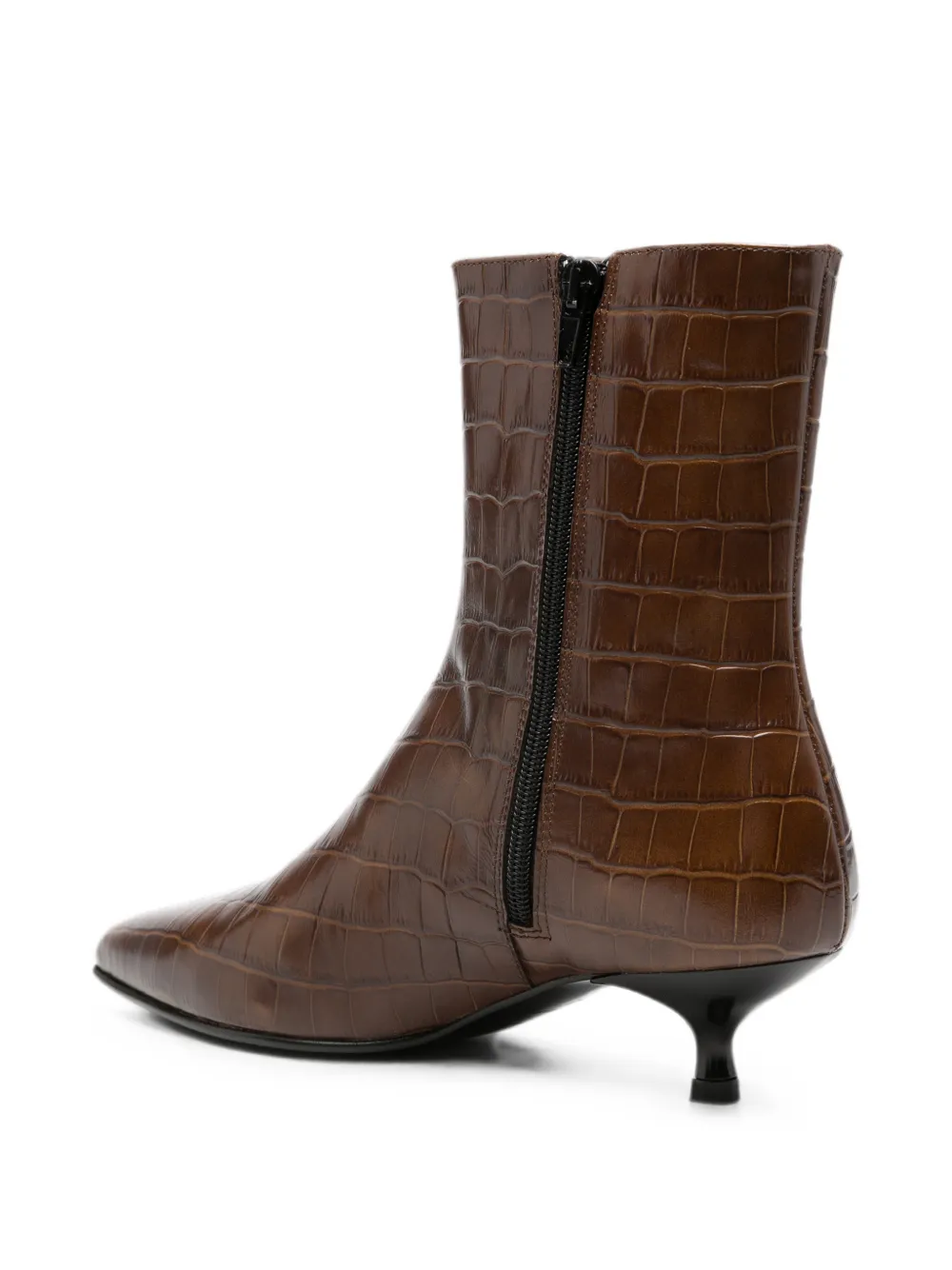
Turn a single product photo into a realistic 3D model, usually in about 5 minutes. Explore it, view it in AR at real size, embed it, or export it to any of 7 formats. Pay as you go from $5, no subscription.
Frequently asked
Does the OBJ include materials and textures?
The geometry and UV coordinates come across, but this tool writes the .obj only, not the companion .mtl material file or the texture images. Your editor will open the shape with correct UVs and you can reassign materials there.
Why convert to OBJ rather than keep GLB?
Older pipelines and some CAD and sculpting tools read OBJ but not glTF. OBJ is also plain text, so it is easy to inspect or script against. If your target application accepts GLB, keep GLB: it carries materials, textures and animation in one file.
Is anything uploaded?
No. The file is parsed and re-exported in your browser. Nothing is sent to a server and there is no sign-up.
What happens to animations?
They are dropped. OBJ is a static format with no concept of skinning or keyframes, so you get the mesh in its rest pose. Keep the original GLB if you need the animation.
What is an OBJ file?
OBJ is the Wavefront format from the early 1990s: a plain-text list of vertex positions, normals, texture coordinates and faces. Materials live in a separate .mtl file that points at image files. Almost every 3D application ever written can import it, which is the whole reason it survives.
Why does the model open grey in my editor?
Because the materials did not travel. OBJ keeps them in a sidecar .mtl file this tool does not write, so the editor shows untextured geometry with correct UVs. Load the texture images from the original GLB onto the mesh and it will look right again.
Are separate meshes kept separate?
Yes. Each mesh in the GLB is written as its own named group in the OBJ, so your editor can still select and edit the parts individually rather than receiving one welded blob.
My GLB uses Draco or meshopt compression. Will it work?
Meshopt-compressed files convert fine; the decoder is built in. Draco-compressed files are refused with a clear message rather than converted badly. Re-export the file without Draco compression and try again.
Does it work on a phone, Mac or Windows?
Yes. It runs in the browser, so any current browser on any operating system works. Very large meshes are limited by the device's memory, so a big file that fails on a phone will usually convert on a laptop.
OBJ or STL for 3D printing?
STL, almost always. Slicers read OBJ too, but they ignore the UVs and materials that are OBJ's only advantage, and STL is the format every printer workflow and print service is built around. Use OBJ when the destination is an editor, not a printer.
Made with 2dto3D
See the full gallery



Last updated 2026-08-20